




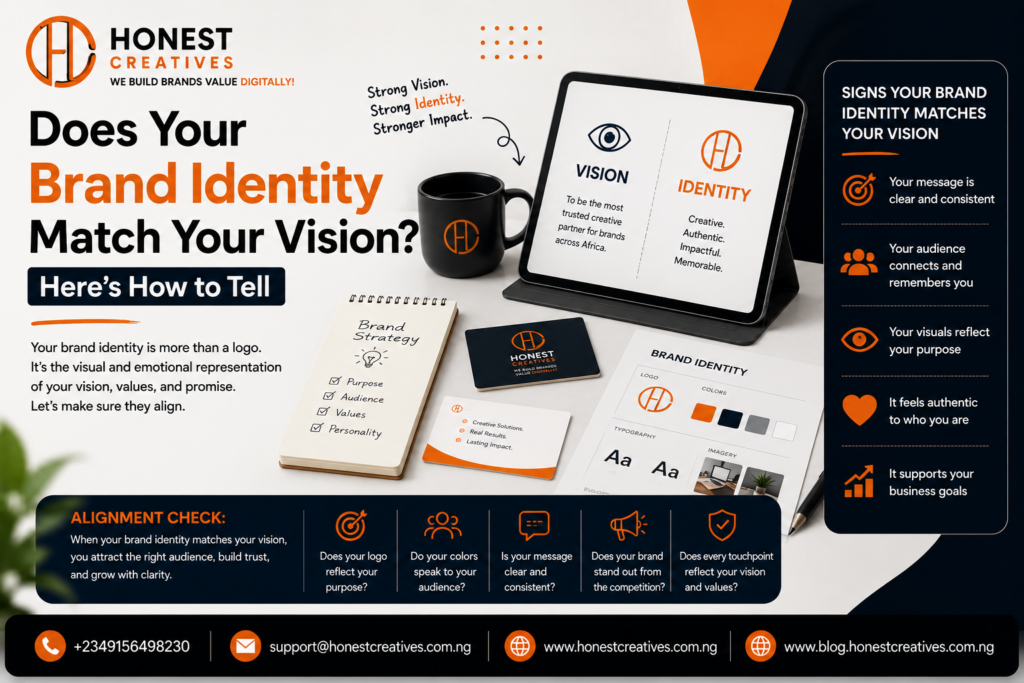
Does Your Brand Identity Match Your Vision? Here’s How to Tell
When you first launched your business, your brand identity was likely built around a specific goal. Maybe it was to solve a local problem, disrupt an industry, or launch a single flagship product.
Fast-forward a few years. Your offerings have evolved, your audience has matured, and your long-term ambitions look completely different. But has your visual and verbal identity kept up?
A misalignment between where your business is going and how your brand looks and feels is one of the biggest hidden growth killers. Here is how to audit your brand to ensure it actually reflects your vision and what to do if it doesn’t.
The Cost of a Misaligned Brand
When your vision outgrows your brand identity, you end up sending mixed signals to the market.
- You attract the wrong clients: Your high-value vision promises premium solutions, but your outdated logo and copy signal budget-level service.
- Internal confusion builds: Your team struggles to explain what the company does because the public-facing messaging doesn’t match internal goals.
- Sales friction increases: Prospective buyers feel a disconnect between what you say in sales calls and what they see on your website.
4 Warning Signs Your Brand Identity Has Fall Behind Your Vision
1. You Avoid Directing People to Your Website
If you find yourself saying, “Check out our pitch deck instead of our website, it’s more up to date,” that is a glaring red flag. Your primary digital home should always lead the charge, not fall behind it.
2. You’ve Shifted Audiences, But Your Tone Haven’t
If your target customer has shifted from small business owners to enterprise leaders, your conversational, casual tone might need to elevate into something more authoritative and strategic.
3. Your Visuals Look Like Everyone Else in the Industry
When you started, fitting in was safe. But if your vision is to lead or disrupt the market, relying on stock photography, standard color palettes, and generic templates actively works against you.
4. Your Value Proposition Takes More Than Two Sentences to Explain
A clear vision produces simple, punchy messaging. If explaining what you do requires a paragraph full of industry buzzwords, your brand messaging lacks the focus your vision demands.
A Quick 3-Step Audit
To quickly diagnose where you stand, ask yourself and your team these three questions:
- Purpose: Does our visual identity convey the scale and ambition of our 5-year goal?
- Positioning: If a total stranger lands on our homepage, will they instantly know WHO we help and HOW?
- Perception: What are the top 3 adjectives customers currently use to describe us and do they match the 3 adjectives we WANT them to use?
What to Do Next
If you realized there’s a gap between where you are and where you’re going, you don’t always need a full, expensive top-to-bottom rebrand.
- A Brand Refresh might just involve updating your typography, refining your color palette, and sharpening your website copy.
- A Full Rebrand is necessary if your business model, core target audience, or primary product line has fundamentally changed.
Your brand identity isn’t just a wrapper for your product, it’s the vehicle that carries your vision to the world. Make sure it’s built for where you’re going, not just where you’ve been.
Send us a brief now to get started.